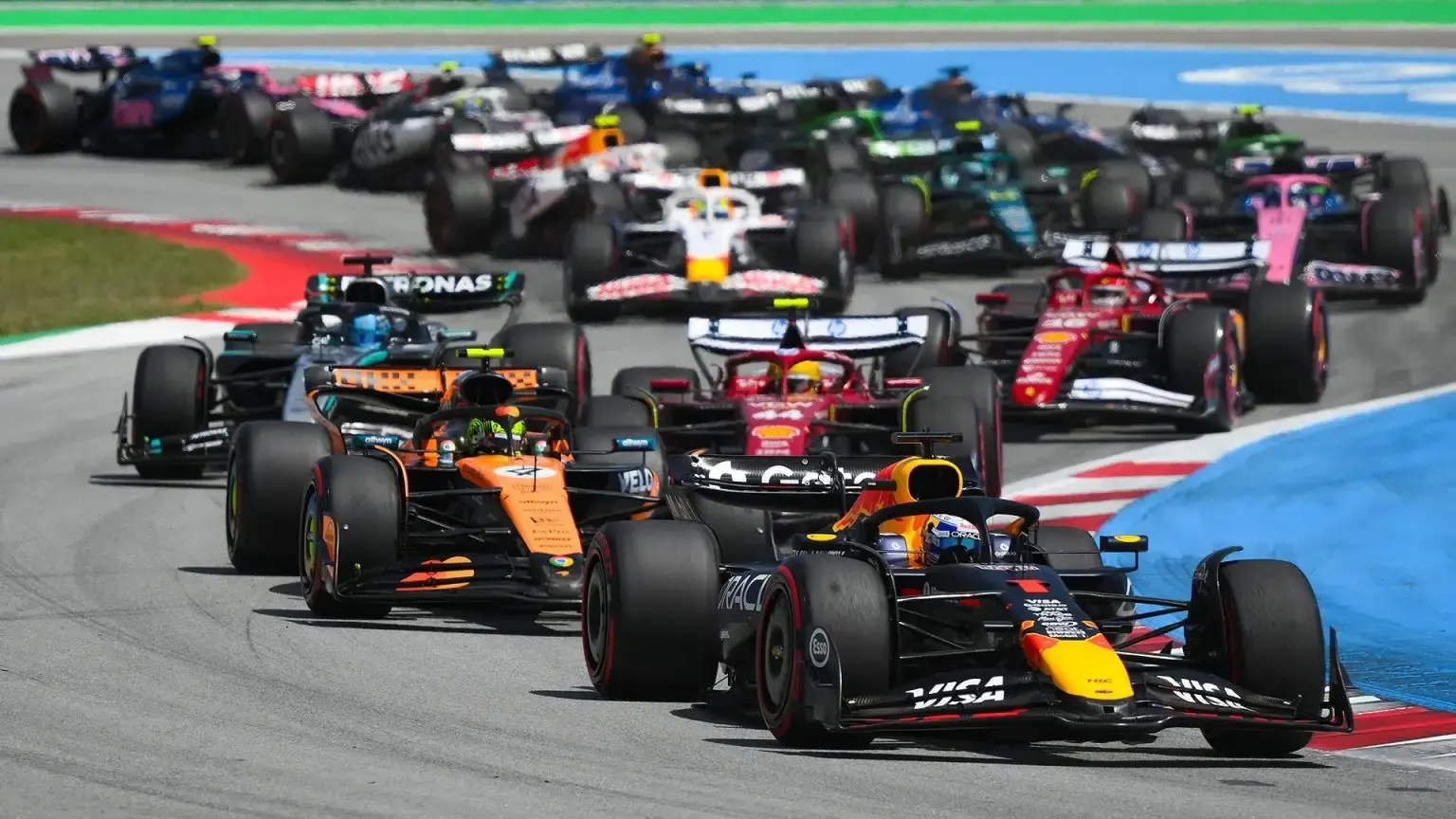
Okay bestie, you’ve seen all your friends talking about F1, or maybe you’re chatting to a guy on Tinder who’s super into the motorsport. Maybe you’ve been watching Drive to Survive and fancied a driver. No judgement here, we all have to start somewhere. Whether you’re here to get into a new hobby, because you’ve seen F1 drivers wearing mega expensive watches, you’re into the team drama that feels like a reality show, or you just want to be the tyre strategy expert on a Sunday, we’ve got you covered with your F1 beginner’s guide.
The problem with F1 is that everyone seems to assume you’re already in the know. They’re throwing around words like undercut, overtake mode, parc fermé, and you have no idea what’s going on. So here’s F1 explained without making you feel like you need a degree.
Formula 1 (regularly abbreviated as F1, because nobody has time to say the full thing every time) is the highest level of single-seater racing in the world. It’s where the fastest circuit drivers, most-qualified engineers, and biggest motorsport teams come together to battle it out across a season of races, each one called a Grand Prix.
Imagine the most competitive group project ever, except instead of completing it for merit, the prize is a championship trophy, and the cars go over 200mph.
What does Formula 1 actually mean?
Well, the “Formula” part comes from the rules. Each F1 team has to build their car adhering to a very strict set of regulations. Things like the size of the car, safety features, aerodynamics, and engine rules are all controlled by the sport’s governing body, the FIA. The “1” means it’s top tier, which is why you’ll also see Fast Girls Club chatting about F2, F3, and the F1 Academy. You might recognize some drivers in F1 as former competitors in F2 or F3. It’s not a pre-requisite, but it’s a pretty great motorsport career ladder.
How does an F1 weekend work?
Despite what some may think, you can’t just turn up on Sunday, blast your car around the track, and take home the winnings. Although that is the fun part. A race weekend usually happens over three days. Friday is usually a practice session or two, where drivers go out on the track, learn the circuit, test different setups, and figure out what makes their car happy. Because, yes, even a multi-million-pound racing car can have a bad day.
On Saturday you’ll see qualifying. This decides the order in which everyone starts the race. It can get pretty spicy. The fastest driver gets pole position, which means they start at the very front of the grid. Everybody wants that because starting at the front usually means an easier race, as long as you have a good start.
Qualifying happens in three stages:
💗 Q1: Everyone fights for a place
💗 Q2: The field gets smaller
💗 Q3: The fastest drivers battle for pole
In each stage, some drivers will not advance to the next stage. By the time Q3 rolls around, there are just 10 drivers battling for pole position.
Sunday is your race day. The main event. Drivers line up on the grid and race to complete the required number of laps. The first one across the finish line wins. Sounds simple, right? Well … kind of. There are factors that make it a bit more complicated than that, in the best possible way.
Why doesn’t the fastest car always win?
Winning isn’t just about driving fast, or having the best car. It’s about the entire team working together. Some things that could change the race outcome include:
🏎️ The driver’s skill
🔧 Car upgrades
🧠 Strategy decisions
🌦️ Weather
🛞 Tyre choices
🚨 Safety cars
If the driver going the fastest, with the best car, and starting on pole position has a bad pitstop or the team chooses the wrong moment to pit, it could all go wrong. Similarly, if someone in a slower car makes perfect decisions, they could pull off an incredible result.
Who are the F1 teams?
There are currently 11 teams in Formula 1, with each team running two cars for a total of 22 drivers. Every team has its own personality, history, budget, and (let’s be real) level of chaos. Some ae championship legends, some are fighting their way back up to the top, and some are newcomers just trying to prove that they belong there too. Some you’ll know, and some you’ll be less familiar with:
🐎 Ferrari
The iconic red team. When you think of a racecar as a kid, be honest, it’s red isn’t it? Ferrari is the oldest and most famous F1 team. Founded in 1950, they’re pretty much royalty. Their passionate fans, known as the Tifosi, are the most dedicated in the sport.
🩶 Mercedes
The modern powerhouse. Nobody’s sure what they’re putting in the Mercedes, but it’s fast as heck. Mercedes became one of the most dominant teams in F1 history during the hybrid era. They’re known for their impressive engineering, and it’s where Lewis Hamilton got the majority of his championship titles.
🔵 Red Bull Racing
Red Bull entered F1 in 2005 and quickly transformed from the fun newcomer to the championship-winning machine. Their bold designs, aggressive racing, and talented drivers make Red Bull one of the defining teams of the modern era.
🧡 McLaren
Comeback queens. McLaren is one of F1’s most historic teams, with decades of success. After struggling for years, McLaren rebuilt itself and returned as a championship winner, with their driver Lando Norris getting his first championship title behind the wheel of one.
💚 Aston Martin
Aston Martin is a name we all know, but they’re pretty new to F1. They’ve had major investment and they’ve got big ambitions, but they’re struggling to realise them.
🟦 Alpine
Alpine are French, and their name is fun to say with a French accent. Alpine is Renault’s current F1 team name, so they carry the history of a manufacturer that has achieved championship success before.
🟢 Williams
Williams is one of the most successful teams in F1 history, with multiple championships and some of the sport’s greatest names connected to it. After years of struggling, Williams has been working on a major rebuild to return to its former glory.
🟠 Haas
Haas is the American underdog. Having joined F1 in 2016, they were the first American-led team in decades. Haas doesn’t build every component of its cars itself, unlike many teams. Instead, it works closely with technical partners. They’re the scrappy team always looking for a surprise result.
⚫ Racing Bulls
Racing Bulls is the sister team to Red Bull, and traditionally is a place where younger or more inexperienced drivers prove they’re ready to drive a Red Bull. Lots of famous F1 names have had a Racing Bulls seat.
⚪ Audi
Formerly Sauber, the Audi team is currently in its first season under that name. Sauber has a long F1 history, but so far Audi is still finding its feet. We’ll know more as the seasons progress.
🩷 Cadillac
Cadillac is another new name on the grid for 2026. Backed by American motorsport ambition, the team represents another major step in F1’s expansion into new markets.
What are the tyres?
Here’s where it gets complex, but don’t worry. We’ve got you. The tyres are one of the first things you need to understand. F1 has different tyre compounds ranging from soft to hard. The softer the tyre, the more grip it provides, but the faster it wears down. The harder the tyre, the less grip, but it lasts longer. An easy way to remember that is:
- Soft: Fast, grippy, wear quickly.
- Medium: Sensible middle child.
- Hard: Less grip, considerably more durable.
There are also intermediate and wet tyres for rainy conditions.
But yes, tyres can completely change the outcome of a race. A driver can be flying around the track, only for their tyres to start wearing too much, and suddenly they’re losing several seconds a lap.
What’s a pit stop?
Pit stops are when the car comes into its garage in the pit lane so the team can do things like change its tyres or make emergency repairs. And they are fast. A good tyre change usually takes around two seconds.
Two.
Seconds.
I take longer than that to decide what I want at Starbucks.
Pit stops can also come into strategy. A team might decide to bring a driver in early to jump another car, stay out longer to gain track position, or react to what another team has done.
If you hear those famous words, “Box, box,” itg means your driver has been called into the pits.
The radio is one of the best parts of F1 because you get to hear drivers and their teams communicating in real time, and sometimes those results are hilarious.
What is an undercut, then?
This is pretty simple, although it sounds complicated. If you’re behind another driver and can’t overtake them, your team might bring you into the pit before they do. Then you’ve got fresh tyres, and faster lap times. Then the driver ahead eventually pits, but your new tyres and faster laps have gained you enough time for them to come out of their pit stop behind you. That’s an undercut.
What about an overcut?
The opposite, almost. Instead of pitting before your rival, you stay out longer. If your tyres are still performing well and your rival struggles on their fresh tyres, you could gain enough time to emerge ahead after your pit stop once you finally make the stop.
Safety cars explained
If there’s an accident, debris on the track, or another dangerous situation, the Safety Car may be deployed. All of the cars slow down and line up behind it while the marshals deal with whatever has happened. This can completely change a race. Imagine you’ve spent 30 laps building up a 20-second lead and then someone crashes, bringing the Safety Car out. Your advantage is all but gone and, congratulations, you’ve just experienced one of the fundamental emotional experiences of being an F1 fan.
What is a red flag?
A red flag means the race or session has been stopped. This can happen because of dangerous weather, a serious accident, or other conditions that mean it’s not safe to continue. Cars will return to the pit lane, and everyone waits to see what happens next.
For us girlies, that usually incites one of two responses:
- “That’s sensible. Safety first.”
- “OMG THIS HAS COMPLETELY CHANGED THE RACE.”
Sometimes both. That’s okay.
What is parc fermé?
Pronounced park fair-may, because F1 loves making perfectly normal things sound French. Parc fermé means the cars are subject to restrictions on what the teams can change, especially around qualifying and the race.
It basically means that teams can’t qualify with a magical setup and then rebuild the car overnight for Sunday’s race.
What’s a grid penalty?
Sometimes a driver receives a penalty that affects where they can start the race. This could happen because of engine or component changes, or other sporting infringements. So, you might see someone qualify third but start the race eighth. This is why you might hear F1 fans saying, “Yeah, but what’s the grid position?”
Why does everyone care so much about the weather?
Rain ruins everyone’s plans. A dry race can suddenly become wet, meaning tyres need to be changed, pit stops become crucial, grip disappears, visability becomes terrible. Suddenly a driver who’s been struggling all weekend is somehow race leader. Rain is F1’s biggest nemesis.
What do all of the flags mean?
You don’t need to memorise every flag immediately, but a few are worth knowing.
🟢 Green: Track is clear.
🟡 Yellow: Danger ahead. Slow down and don’t overtake.
🔴 Red: Session stopped.
🔵Blue: Warns driver that a faster car is approaching from behind to lap or pass them. Ignoring it results in a penalty.
⚪White: Tells drivers about a slow-moving car ahead.
🟨🟥Yellow and Red Striped: Reduced grip or slippery surface due to oil, water, or debris.
🟧⬛Black and Orange: A car has mechanical damage or technical issues and needs to go into the pit lane.
🏁 Chequered flag: It’s over. Someone has won.
🏴Black: Disqualified. Go back to your garage and think about what you’ve done.
🏴☠️ Black-and-white: Warning for unsportsmanlike behaviour or another infringement.
The most important one is the chequered flag because it means you can finally unclench your entire body.
How are races scored?
Points are awarded to the drivers that finish highest in the race. At the end, the driver with the most points becomes World Champion. The team with the most Constructors’ Championship points wins a separate Constructors’ Championship. Points are only awarded for the top ten drivers in each race.
Do I need to understand all of this?
No. Please don’t. The best way to learn about F1 is to watch it and gradually start recognising what everyone’s talking about.
At first you’ll hear, “He’s going long on the hards,” and you’ll think, “What the fuck does that mean?”
Three races later you’ll be screaming because of a weird tyre strategy.
This is how it happens. Learn the drivers. Learn the teams. Develop your own opinions. Recognise circuits. Get a favourite driver. Gain an irrational hatred of a particular team.
Eventually, someone will start talking to you about an undercut and instead of looking confused, you’ll nod knowingly, and not be faking it.
Congratulations, you’re an F1 girly now.
Well, enough of one to start arguing about it on Twitter, anyway.
Welcome to the Fast Girls Club.